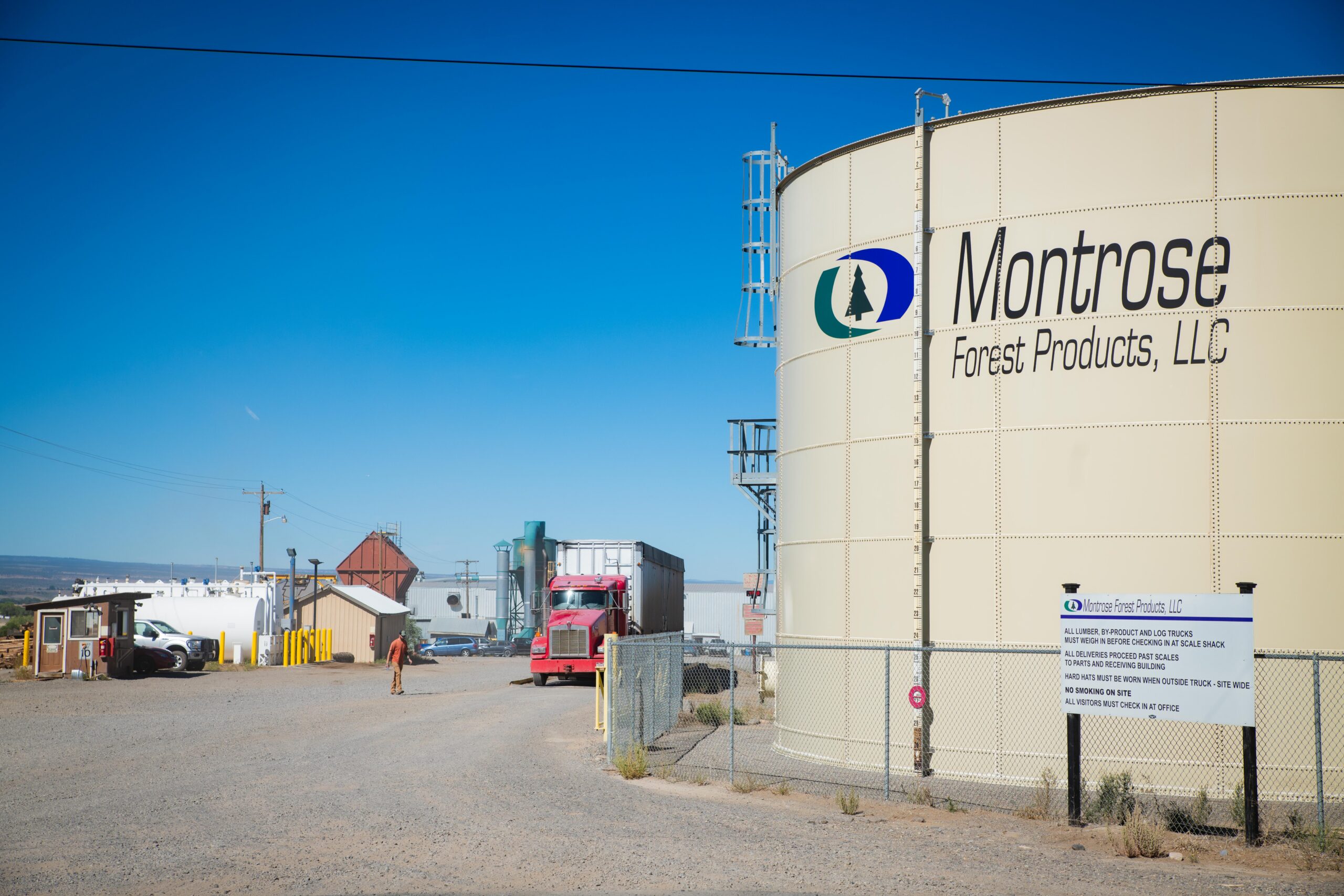
The clock is running to find a buyer for Colorado’s largest sawmill, with Montrose Forest Products saying a deal ideally needs to be secured before Nov. 6 to preserve its workforce and avoid an interruption in operations.
Neiman Enterprises issued federally required Worker Adjustment and Retraining Notification Act notices to around 90 Montrose Forest Products employees this week, warning of a potential closure. The notices list Nov. 6 as the end of the 60-day notice period.
“My heart is with our employees, contractors and their families,” said Jim Neiman, president of Neiman Enterprises, in a statement. “Many have dedicated decades of their lives to this mill and have stood beside us through some very difficult years.”
Sonja Neiman, community relations manager for Neiman Enterprises, said the possibility of closure is real, but a final outcome has not been determined and efforts are underway to sell the mill as an operating facility.
“The possibility is real, which is why we were required to issue the WARN notices,” Neiman said. “At the same time, a final outcome has not been determined. We are continuing to pursue every viable opportunity to find a buyer and preserve the mill as an operating business.”
Montrose Economic Development Corporation Executive Director Sandy Head said MEDC is working alongside Neiman Enterprises on several potential scenarios and remains hopeful the mill can be saved.
“It’s not a done deal. We’re still working,” Head said. “There are several scenarios, and we’re working on one in particular. We’re hoping to save it.”
Head said MEDC has worked with Neiman Enterprises for a long time and is actively involved in efforts to keep the mill operating.
Neiman confirmed MEDC and other organizations and government agencies are exploring potential solutions, although confidentiality agreements prevent the company from identifying prospective buyers or discussing financing structures and negotiations.
“What we can say is that MEDC and other organizations and agencies are actively exploring potential solutions that could support the sale of Montrose Forest Products as an operating, turnkey facility,” Neiman said. “We appreciate the urgency and commitment they are bringing to this effort.”
Finding a buyer, however, is only part of what would be required to secure the mill’s future.
Neiman said a prospective owner would also need confidence that the mill can obtain a reliable and affordable long-term supply of timber.
“Colorado has no shortage of forests that need treatment, but enough timber must reach the mill consistently and economically for the operation to remain viable,” she said. “The problem is not a lack of forest-management need. What is missing is a reliable, affordable timber supply that sustains the mill over the long term.”
The timber-supply problem has been building for years, Neiman said. Recent efforts have improved timber availability but have not resolved the long-term challenge.
Neiman Enterprises has worked with the U.S. Forest Service, state and federal leaders, conservation organizations and other partners for years. Neiman said the immediate need is a solution that gives a prospective buyer confidence in the mill’s future, including help assembling an affordable, long-term timber supply.
The stakes, Neiman emphasized, extend beyond the mill and its workforce.
Montrose Forest Products is Colorado’s largest sawmill and an important market for commercial timber removed during forest-management work. Without a nearby destination for that timber, Neiman said some forest-management projects could become more expensive, more difficult to design and, in some cases, economically impractical.
“The overall impact is much larger than one operation and one community,” Neiman said in a follow-up email. “The health of our forests is critical to wildlife habitat, watershed health, recreation, etc.”
In her written responses, Neiman described the Montrose mill as an essential part of Colorado’s forest-management infrastructure.
“If that infrastructure is lost, the need for forest restoration does not go away,” she said. “The work becomes more difficult, more expensive and, in some cases, far less achievable.”
She said healthy forests also protect communities, reduce wildfire risk and support the headwaters of major rivers.
“This is bigger than one company or one community,” Neiman said. “Healthy forests protect communities, reduce wildfire risk and support the headwaters of major rivers that flow downstream to 18 states and Mexico. The consequences of losing this infrastructure could be felt for decades and generations.”
For the mill itself, Nov. 6 is a critical date.
Neiman said a solution ideally would be secured before then. Keeping the mill operating continuously and retaining its experienced workforce would give a new owner an opportunity to succeed.
“This team has spent years developing the specialized skills needed to operate the mill safely and efficiently,” she said. “Once that workforce leaves, restarting the operation becomes significantly more difficult and expensive.”
All mill employees are currently working, and Neiman said operations are expected to continue during the WARN period.
A sale of the mill as an operating facility could preserve those jobs, although employment levels and other operating decisions would ultimately be determined by a new owner.
Neiman said the company therefore cannot guarantee that every position would remain unchanged.
The economic effects of the mill’s uncertain future are already extending beyond just the mill employees.
Montrose Forest Products generally works with eight independent logging contractors representing approximately 50 people, Neiman said. Those workers are separate from the mill employees covered by the WARN notices.
Because of uncertainty about the mill, many of those contractors have already had to seek or accept work elsewhere. Only two of the eight contractors remain working with Montrose Forest Products.
Some contractors could find work through stewardship projects and other timber sales offered by the Forest Service, Bureau of Land Management and state agencies, Neiman said. But without Montrose Forest Products, contractors would have fewer places to take the commercial timber they remove.
Neiman also emphasized that the company is not assigning blame for the situation.
“We appreciate the work of the Forest Service and our other partners,” Neiman said. “This is not about assigning blame. It is about recognizing the urgency of preserving Colorado’s ability to manage its forests.”
Justin Tubbs is the Montrose Business Times editor. He can be reached by email at justin@montrosebusinesstimes.com or by phone at 970-765-0915 or mobile at 254-246-2260.