

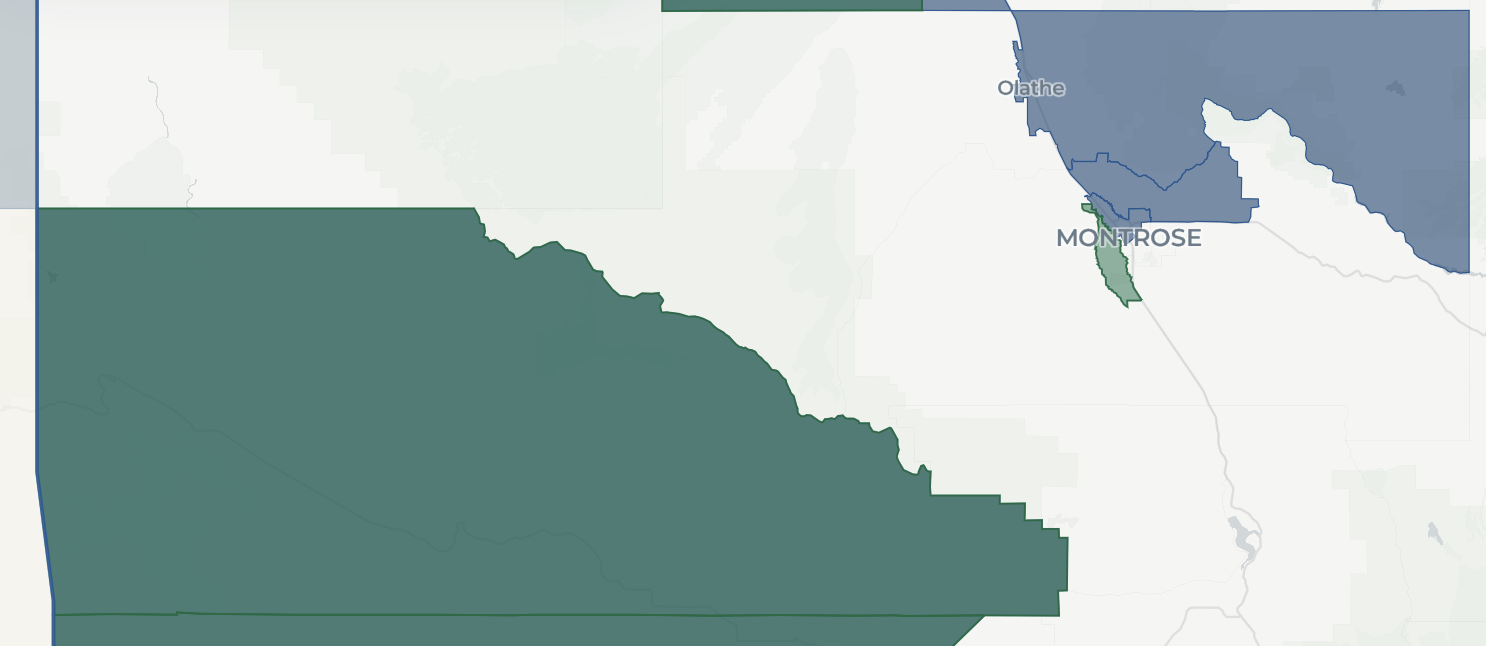
Montrose County will retain access to federal Opportunity Zone tax incentives under a revised program taking effect in 2027, but new boundaries will exclude some of the city’s most prominent areas of commercial and residential development, including Colorado Outdoors and properties near Montrose Regional Airport.
The changes come as the federal government prepares to overhaul the Opportunity Zone program, making it permanent while expanding tax incentives for investments in rural communities.
Colorado submitted its final list of 91 census tracts for the new round of Opportunity Zone designations in September, including two in Montrose County. The nominations await certification by the U.S. Department of the Treasury, with the new designations scheduled to take effect Jan. 1, 2027.
Today, Oct. 28, was designated the Treasury deadline for nominations.
In Montrose, the new designation encompasses a substantial portion of the western and southwestern parts of the city, primarily west of Townsend Avenue. Areas largely north of West Main Street, including the Colorado Outdoors development area along the Uncompahgre River, are no longer included. Properties along the airport corridor on the east side of the city also fall outside the new boundaries.
The changes extend well beyond Colorado Outdoors. The new designations also exclude two much larger census tracts north and northeast of Montrose, including a broad area stretching north toward Olathe. Together with the smaller tract encompassing Colorado Outdoors and portions of northern downtown Montrose, the exclusions remove Opportunity Zone eligibility from a substantial geographic area of northern Montrose County.
The exclusion on the tract that included Colorado Outdoors prompted the City to seek federal reconsideration, but the effort was unsuccessful.
Anthony Russo, who works in business development for the City of Montrose, said the city recognized the potential implications of losing the designation in an area that has attracted considerable investment and remains positioned for future development.
“Some of the biggest investments we can possibly get would be on that side,” Russo said, pointing to the airport corridor and Colorado Outdoors.
Russo said the city worked with the Colorado Office of Economic Development and International Trade to petition the U.S. Department of the Treasury to restore the tract to the list of eligible areas.
“We worked with them quite a bit to try to get a letter built out for them to utilize to send to the Treasury Department to petition and get that tract put back on,” Russo said.
The state ultimately submitted requests for two additional census tracts, one in Montrose County and another in Las Animas County. Both were rejected by the Treasury Department in September.
Despite the setback, Russo said the loss is unlikely to significantly hinder Montrose’s economic development efforts.
“It hurts to lose it. Absolutely,” he said. “Is it going to be detrimental to our community? No.”
A sign of economic progress
Opportunity Zones were established under the federal Tax Cuts and Jobs Act of 2017 to encourage private investment in economically distressed communities.
The program allows investors to reinvest eligible capital gains through Qualified Opportunity Funds, receiving preferential federal tax treatment in exchange for making long-term investments in designated areas.
The revised program introduces stricter eligibility requirements, generally lowering the median family income threshold for qualifying census tracts from 80% to 70% of the surrounding area’s median income, subject to other criteria.
That means some areas that qualified under the original program are no longer eligible.
Russo said the exclusion of northern Montrose reflects, at least in part, the economic progress made in the area since the original Opportunity Zones were established.
He pointed to investments in residential properties north of Main Street, improvements to commercial buildings and continued development within Colorado Outdoors.
“As much as we want to say this is a bad thing, you know, we lost this tract, at the same time, that means that that tract has shown economic growth,” Russo said.
David Dragoo, head of the Colorado Outdoors development area along the Uncompahgre River, offered a similar assessment.
He said the program helped bring attention to rural communities that might otherwise have struggled to compete with larger metropolitan areas for investment.
“I thought what it did was it put these rural areas on a level playing field with urban areas for a time period,” Dragoo said. “And so it brought exposure to these areas.”
He said the economic improvements that followed, both from Opportunity Zone investments and other development, have changed the eligibility of some census tracts.
“Those areas got improved. Incomes went up and now they’re not eligible,” Dragoo said.
He pointed to expansion at Montrose Regional Airport, new industrial development, Amazon’s delivery station and investment around the Colorado Outdoors area as examples of the economic growth in northern Montrose, even though most projects in that area didn’t utilize the Opportunity Zone benefits.
“It’s now kind of graduated out,” Dragoo said.
How the original program was used
Although Opportunity Zone incentives helped attract attention to Colorado Outdoors, Dragoo said relatively few individual projects ultimately used the program.
Colorado Outdoors is a roughly 165-acre development area along the Uncompahgre River intended to accommodate multiple independently financed commercial, industrial, hospitality and residential projects.
Dragoo said that of approximately 15 or 16 projects within the area, only two utilized Opportunity Zone financing: Shelter Distilling and the hotel project.
The designation was initially used as a marketing tool to attract potential investors, but most projects proceeded through conventional financing arrangements or other tax strategies.
“The opportunity zone was — it’s been great, but it only makes great investments into fabulous ones,” Dragoo said. “It doesn’t make good ones great ones.”
Dragoo said the majority of investments within Colorado Outdoors have instead used traditional real estate financing or 1031 exchanges, which allow investors to defer certain capital gains taxes when exchanging qualifying investment properties.
He said the Opportunity Zone designation helped generate conversations with prospective investors, but projects ultimately needed to make financial sense independently of the incentives.
“It certainly generated the discussion, but the discussions all came back to is this a good investment without the Opportunity Zone,” Dragoo said.
Shelter Distilling, a distillery and restaurant within Colorado Outdoors, was among the projects that benefited from the original program.
Dragoo said the project was particularly well-suited to Opportunity Zone financing because it involved vacant land.
“The ones that make the most sense are ones that are vacant land,” he said, explaining that the program’s requirements for improving existing properties can make redevelopment projects more complicated.
Russo also identified Shelter Distilling as a local project that utilized Opportunity Zone incentives.
He said another housing project in the area considered using the program but ultimately opted against it because of the restrictions and timing requirements.
“They just paid the tax because they didn’t want to deal with the time frames,” Russo said.
The original program required investors to meet specific deadlines for investing eligible capital gains, while qualifying funds also faced requirements governing how quickly capital could be deployed.
Those restrictions could create complications when projects experienced delays.
Despite losing the designation, Dragoo said he does not expect the change to substantially alter development plans at Colorado Outdoors.
“Fundamentally it doesn’t really change what we’re doing,” he said.
He expects future hotel and housing projects in the area to be driven primarily by market demand rather than federal tax incentives.
Camp V shows rural investment potential
The original Opportunity Zone program also helped finance development elsewhere in Montrose County.
One example is Camp V, a former mining company town near Naturita that has been transformed into a destination featuring lodging, camping, art installations and outdoor recreation.
According to previous reporting by The Colorado Sun, the project received a $3 million investment from Four Points Funding, a real estate investment firm focused on Opportunity Zone projects in emerging Colorado communities.
Camp V founder Natalie Binder and her partners, Bruce and Jodie Wright, purchased the former Vanadium Corp. property in 2017 and developed it into a tourism destination that opened in 2021.
The project showed how Opportunity Zone financing can support the redevelopment of existing properties in rural communities where attracting outside investment can be challenging.
In the 2023 report, Binder described the difficulty of securing financing for projects in smaller, less-developed communities.
“It’s difficult to attract investors to underserved, undeveloped communities like ours,” Binder told The Colorado Sun.
The investment also helped bring visitors and economic activity to the surrounding West End communities, according to the report.
Unlike the excluded area in northern Montrose, the West End will remain eligible under the new Opportunity Zone designations.
The revised program could provide additional incentives for investors considering similar projects in the region.
Better rural incentives
One of the most significant changes to the Opportunity Zone program is an increase in the tax benefits available for qualifying rural investments.
Under the original program, investors could defer taxes on eligible capital gains reinvested through Qualified Opportunity Funds until Dec. 31, 2026.
Investors who entered the program early enough could also reduce the amount of their original gains subject to taxation by 10% after five years and an additional 5% after seven years.
The revised program replaces the fixed deferral deadline with a rolling five-year period, allowing investors to defer taxes for up to five years from the date of a qualifying investment.
It also provides a larger reduction in taxable capital gains for investments made through
Qualified Rural Opportunity Funds.
Under the new rules, investors who hold qualifying rural investments for at least five years can exclude 30% of their original deferred capital gains from taxation, compared with 10% for investments in nonrural Opportunity Zones.
For example, an investor who reinvests $1 million in eligible capital gains through a qualifying rural Opportunity Fund could reduce the amount of those gains subject to taxation to $700,000 after five years.
That means a substantial increase over the original program, which offered a maximum reduction of 15% for investors who met the applicable holding-period requirements.
The benefit is separate from another major feature of the Opportunity Zone program: the potential exclusion of federal capital gains taxes on appreciation in the value of qualifying investments held for at least 10 years.
That incentive, which was available under the original program, remains part of the revised framework, subject to updated rules.
Lower barriers for redevelopment
The federal changes also reduce the amount investors must spend improving existing buildings in qualifying rural Opportunity Zones.
Under the original program, developers purchasing existing properties generally had to invest an amount equal to the building’s adjusted basis to satisfy the substantial improvement requirement.
For example, a developer purchasing a building with an adjusted basis of $500,000, excluding the land, generally would have needed to spend another $500,000 improving the structure.
Under the revised rural rules, that requirement has been reduced to 50% of the building’s adjusted basis.
In the same example, the developer would generally need to spend $250,000 on improvements rather than $500,000.
Russo identified the change as one of the more attractive features of the revised program.
“Instead of you having a one-to-one reinvestment ratio, it’s a 0.5-to-one, so that’s a big deal,” Russo said.
The change could make rehabilitation of existing commercial buildings more financially feasible, particularly in smaller communities where construction costs can present significant obstacles to redevelopment.
Unlike the new Opportunity Zone boundaries, which take effect in 2027, the reduced rural substantial improvement requirement took effect July 4, 2025, and also applies to qualifying rural properties in existing Opportunity Zones.
The revised Opportunity Zone program was established under federal legislation signed into law in July 2025, making the incentive permanent and requiring new geographic designations every 10 years.
Colorado identified 362 eligible census tracts under the revised criteria and nominated 91, the maximum number permitted under the federal program.
The original Opportunity Zone designations remain in effect through 2028, creating a transition period during which the original and revised programs overlap.
Justin Tubbs is the Montrose Business Times editor. He can be reached by email at justin@montrosebusinesstimes.com or by phone at 970-765-0915 or mobile at 254-246-2260.


