Montrose Business Times
Fall colors are beginning to spread across Colorado’s Western Slope, with some of the highest elevations in the San Juan Mountains nearing peak color while lower elevations remain earlier in the seasonal transition.
As of Sept. 22, the San Juan National Forest listed the stretch from Molas Pass to Silverton and the Silverton area as near peak, making the high country south of Montrose one of the more advanced areas for fall color.
Colors were listed as partial between Silverton and Red Mountain Pass and from Red Mountain Pass to Ouray. The Ouray-to-Telluride stretch around Dallas Divide remained patchy, while Lizard Head Pass to Telluride and Rico to Lizard Head Pass were listed as partial.
Farther south, the season is less advanced. Colors were minimal between Durango and Purgatory and around Mancos, while the Purgatory-to-Coal Bank Pass, Coal Bank-to-Molas Pass and Dolores-to-Rico stretches were rated patchy.
Around Pagosa Springs, foliage remained minimal at lower elevations and partial at higher elevations. Missionary Ridge showed a similar pattern, while La Plata Canyon ranged from patchy at lower elevations to partial higher up.
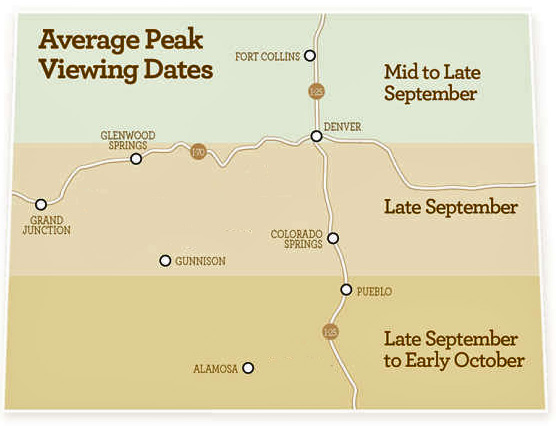
The progression generally follows elevation and latitude, with higher and more northerly stands changing before lower and more southerly areas.
September and early October typically mark the primary fall color season at higher elevations in Colorado, according to the Colorado State Forest Service. In the San Juan Mountains, colors generally begin around Silverton in mid-September and continue into early to mid-October around Pagosa Springs, Purgatory and Dolores.
Aspens account for about 20% of Colorado’s forests and provide much of the state’s characteristic yellow and gold fall color.
Exactly when those colors appear, however, varies from year to year.
Shortening days are the primary seasonal signal that triggers aspens to begin changing, but the timing and quality of fall color can also be influenced by tree health, weather, moisture, drought, elevation and latitude, according to the Colorado State Forest Service.
The color change occurs as trees reduce their food-making process heading into winter. During spring and summer, chlorophyll gives leaves their green appearance and helps convert sunlight into energy. Leaves also contain yellow and orange pigments called carotenoids, but those colors are largely hidden by chlorophyll during the growing season.
As daylight decreases and temperatures change in the fall, chlorophyll production declines and the green pigment breaks down. That allows the yellow and orange pigments already present in leaves to become visible. Quaking aspen is among the tree species whose fall foliage primarily displays yellow.
Weather also influences how vivid fall foliage becomes. Healthy trees are more likely to produce strong colors and retain their leaves longer, according to the Colorado State Forest Service. A wet growing season followed by a dry, sunny fall with cool nights generally favors brighter foliage.
The USDA Forest Service notes that the intensity of fall color can vary not only from year to year but even between different portions of the same tree depending on sunlight and weather conditions.
For Western Slope residents looking for some of the most advanced colors now, the latest San Juan National Forest report points toward the higher elevations around Molas Pass and Silverton.
Those who miss the earliest high-country colors should still have opportunities farther south and at lower elevations. Areas around Durango, Mancos and Pagosa Springs remained relatively early in their transition as of Sept. 22, while portions of the Ouray, Telluride and Lizard Head Pass areas were still developing.
Colorado’s fall color season typically continues into early October as the transition moves from higher elevations into lower country.