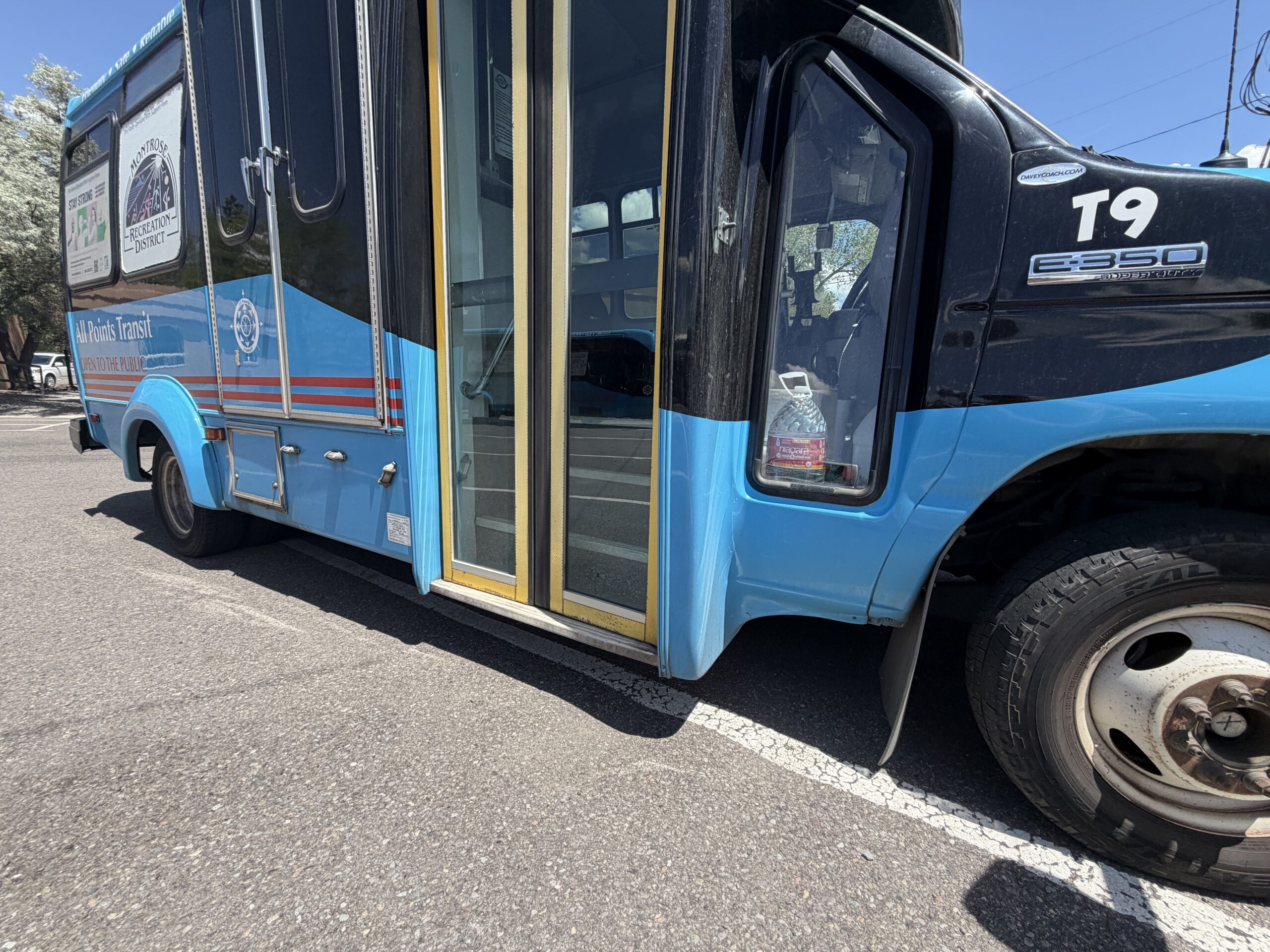
The Montrose City Council has approved a $55,000 allocation to All Points Transit using revenue generated from the city’s voter-approved hotel and lodging tax increase, providing emergency support for a rural transit system facing state funding cuts.
The funding is intended to help offset reductions in state funding, Medicaid reimbursement rates and support from Region 10 that All Points Transit Executive Director Gary Clark said are threatening the organization’s ability to maintain current service levels.
Clark told council members during a May 18 work session that demand for transit services continues to rise even as funding sources shrink.
“The state has been cutting back on funding a lot in a lot of areas,” Clark told council members. “Caring for the elderly and those in need specifically has taken a huge hit this last year and is continuing to decrease.”
According to Clark, All Points Transit’s Dial-A-Ride service alone currently provides between 120 and 200 rides daily and is often booked two to three weeks in advance because of demand.
“That service is where people will call us and they’ll book a ride,” Clark said. “Right now we’re about two or three weeks out. It’s — we’re just that busy.”
All Points Transit operates public transportation routes throughout Montrose, Delta, Ouray and San Miguel counties, including routes between Montrose, Delta and Olathe, routes serving Ridgway and Ouray, and a newer microtransit program that functions similarly to a rideshare service through a phone app.
Clark said the city funding would be used exclusively for services operating within Montrose.
In a statement provided to the Montrose Business Times, Clark said rural transit systems face unique challenges because communities often lack alternative transportation providers or substantial local funding sources.
“Unlike larger urban systems, we don’t have the luxury of multiple transit providers, large tax bases, or extensive local funding sources to fall back on,” Clark said. “In many of the communities we serve, if public transit service is reduced or disappears, there simply is no backup option.”
Clark said many riders rely on the service to maintain access to work, healthcare and everyday necessities.
“In rural Colorado, public transit is not just a convenience,” Clark said. “For many people, it is their only connection to healthcare, employment, groceries, social services, and community.”
He added that demand for service continues to increase among seniors, people with disabilities, workforce riders and residents who cannot afford reliable transportation on their own.
According to the grant application submitted to the city, reductions in funding threaten transportation access for residents who rely on transit services for medical appointments, employment, shopping and other daily needs. The application also noted that transit services support local tourism and businesses by helping visitors access hotels, downtown amenities, events and regional attractions.
Clark said the organization is pursuing grants, partnerships with hospitals and private organizations, operational restructuring and other measures to avoid future service reductions.
Asked whether service cuts were being considered, Clark said commuter routes outside Montrose could eventually be impacted if additional funding is not secured.
“If it came down to it and we had to cut, we’d end up having to cut some of our auxiliary commuter routes between Ouray or Delta,” Clark said. “We have to make sure that our core service of serving those in need here in our community stays the priority.”
City Manager Bill Bell told council members that All Points Transit’s total funding need exceeded the amount approved by the city, though the organization only requested $55,000 from Montrose.
Bell also said the city currently has just under $70,000 available in a funding category reserved specifically for public transit uses under the ballot language approved by voters. He noted the category is not dedicated exclusively to All Points Transit and could potentially support another transit provider in the future, though none currently exists.
“This is in a way a real tribute to the citizens of Montrose for having approved last year the increase in hotel and lodging tax that allows us to do something like this,” Council member J. David Reed said during discussion of the item. “This is proof in the pudding that the citizens were right.”
Montrose voters approved Ballot Issue 2A in November 2024 by a narrow margin, with 5,940 residents voting in favor of increasing the city’s hotel and lodging tax from 0.9% to 6%, compared to 5,698 opposed. The new rate took effect Jan. 1, 2025.
Revenue generated through the increase was intended to use tax dollars largely paid by visitors staying in hotels and other lodging to support community needs including affordable housing, street maintenance, childcare, tourism management, community events and public transit.
At the time the measure was proposed, city research showed Montrose had the lowest lodging tax among surveyed Colorado communities, while the statewide average was approximately 6.7%.
According to the city, approximately $1.26 million had been collected through the tax as of Feb. 20, 2026, including about $63,149 designated specifically for public transit.
The city later established a Hotel and Lodging Tax Allocation Grant Program allowing organizations and businesses to apply for funding generated by the tax. City staff described the All Points Transit request as an emergency allocation needed to preserve essential transportation services.
Justin Tubbs is the Montrose Business Times editor. He can be reached by email at justin@montrosebusinesstimes.com or by phone at 970-765-0915 or mobile at 254-246-2260.