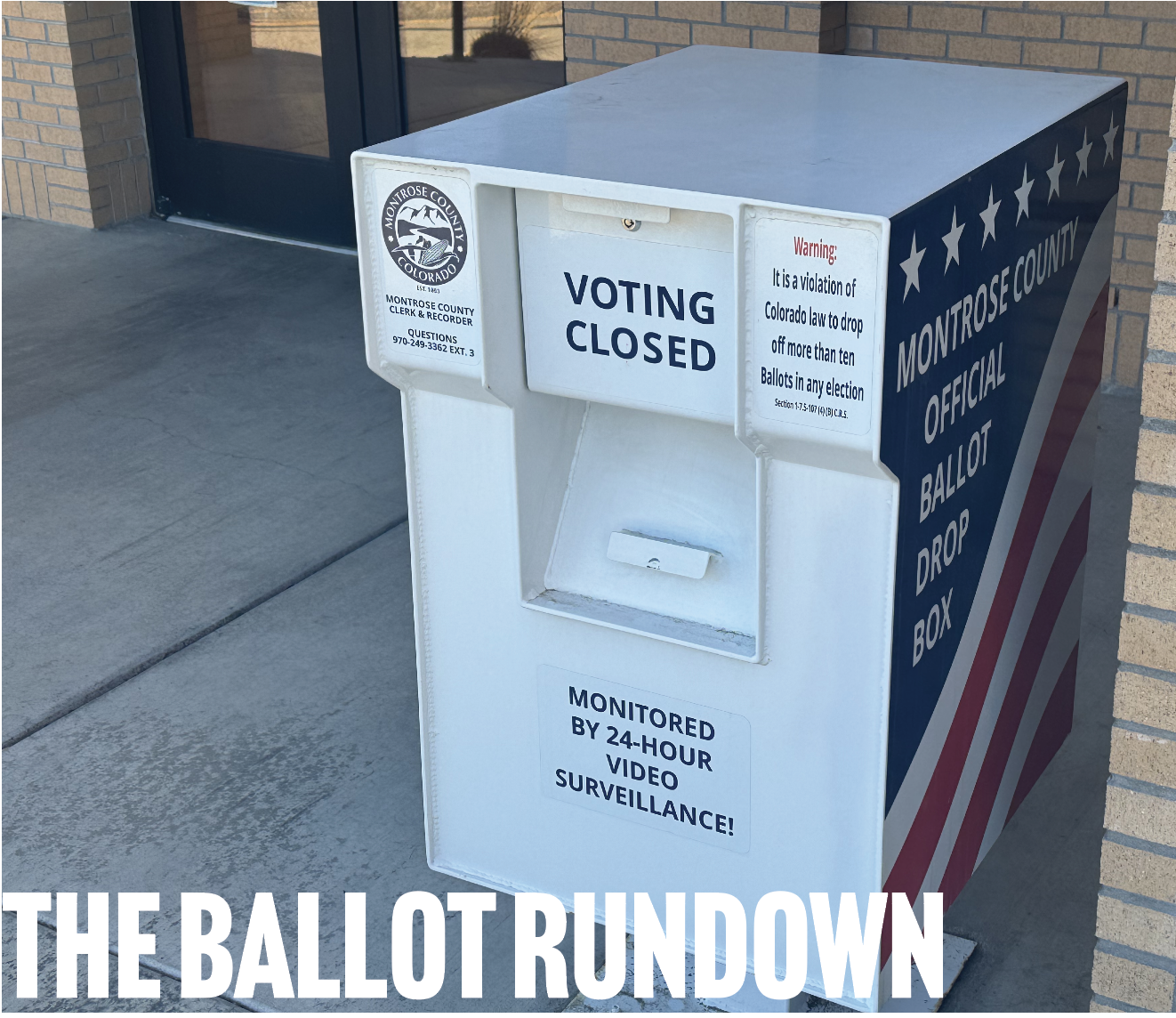
Mail ballots have begun arriving in Montrose County voters’ mailboxes ahead of the Nov. 3 general election, giving residents the opportunity to weigh in on a lengthy list of statewide measures, federal and state races and local ballot questions.
Among the most significant local issues are four proposed amendments to the City of Montrose Charter, which would change the timing of municipal elections, establish new term limits for City Council members and give councilors greater authority over the appointment and dismissal of two city officials.
Those questions will appear only on ballots for voters living within Montrose city limits. Elsewhere in the county, voters in the proposed West End Health Service District will decide whether to establish the district and authorize a property tax to fund its operations.
All Montrose County voters will also consider 14 statewide ballot measures, including proposals addressing income taxes, education funding, immigration enforcement and voting requirements.
With ballots now in voters’ hands and Election Day less than three weeks away, here’s a breakdown of the major races and questions facing Montrose County residents.
City of Montrose charter amendments
Four proposed amendments to the City of Montrose Charter will appear on ballots for city residents. Each question will be decided separately, allowing voters to approve or reject individual changes to the city’s governing document.
Ballot Question 2A: Moving municipal elections
Question 2A would move regular Montrose municipal elections from April of even-numbered years to November of even-numbered years, aligning them with general elections beginning in 2028.
A yes vote would approve the change, while a no vote would maintain the current April election schedule.
Ballot Question 2B: City Council term limits
Question 2B would establish a lifetime limit of eight years of elected service on the Montrose City Council, whether those years are served consecutively or across separate terms.
The restriction would apply to candidates after Nov. 3, 2026. A yes vote would establish the lifetime limit, while a no vote would leave the existing charter provisions in place.
Ballot Question 2C: Appointment and dismissal of police chief
Question 2C would give City Council authority to approve or reject the city manager’s decision to appoint or dismiss the Montrose police chief.
Currently, that authority rests with the city manager. The proposed amendment would not transfer day-to-day supervision of the Police Department to the council.
A yes vote would establish the council approval requirement, while a no vote would preserve the existing arrangement.
Ballot Question 2D: Appointment and dismissal of city clerk
Question 2D proposes a similar change involving the city clerk.
Under the amendment, the city manager would need City Council approval to appoint or dismiss the clerk, while retaining day-to-day supervisory authority.
A yes vote would establish the additional approval requirement, while a no vote would leave that authority with the city manager.
West End Health
Service District
Voters within the boundaries of the proposed West End Health Service District will consider two related questions concerning the creation and funding of the district.
Ballot Question 6A asks whether the district should be established. The proposed district would provide a governmental structure for health services in the West End.
Ballot Issue 6B would authorize a property tax of up to 20 mills, generating an estimated $949,950 annually beginning in 2027, to pay for district operating and capital expenses. The measure would also allow the district to retain and spend revenue beyond limits imposed by the Taxpayer’s Bill of Rights.
The questions apply only to voters within the proposed district’s boundaries, not to Montrose County as a whole.
Statewide
constitutional
amendments
Colorado voters will consider seven proposed amendments to the state constitution, covering immigration enforcement, energy, wildlife management, voting procedures, redistricting and taxes.
Constitutional amendments generally require at least 55% approval to pass.
Amendment 81 — Immigration enforcement: Would require law enforcement to notify the U.S. Department of Homeland Security when a person is charged with a violent crime, or any crime if the person has a prior felony conviction, and authorities cannot determine whether that person is lawfully present in the United States.
Amendment 82 — Natural gas: Would establish a constitutional right for consumers to purchase natural gas for cooking and heating in homes and businesses, and for utilities and distributors to sell it.
Amendment 83 — Hunting and fishing: Would establish a constitutional right to hunt and fish using traditional methods and designate those activities as preferred methods of wildlife management, while preserving the state’s authority to regulate them.
Amendment 84 — Mail ballot identification: Would require voters to include a signature and identifying information, such as the last four digits of a Social Security number or a Colorado driver’s license or identification card number, on the outside of mail ballots. Voters would have an opportunity to correct missing or incorrect information before their ballots could be counted.
Amendment 85 — Ballot language: Would require state and local ballot questions to use plain language written at no higher than an eighth-grade reading level.
Amendment 86 — Congressional redistricting: Would reinforce Colorado’s existing congressional redistricting process and establish additional requirements for modifying final district maps, including public meetings and approval by the redistricting commission and Colorado Supreme Court.
Amendment 87 — Graduated income tax: Would replace Colorado’s flat 4.4% income tax with a graduated system in which tax rates vary by income. The proposal is estimated to generate $2.7 billion annually for public education, health care and early childhood programs.
According to estimates included in the ballot language, average income taxes would decrease for several income groups earning less than $1 million annually and increase for higher-income groups.
Statewide
propositions
Seven additional measures would amend Colorado statutes rather than the state constitution. Unlike constitutional amendments, these propositions require a simple majority to pass.
Proposition NN — Public school funding: Would increase state investment in K-12 education by 2% annually for 10 years, using changes to state spending limits rather than a tax increase. Funding would support teacher pay, retention, smaller class sizes and career and technical education.
Proposition 132 — Fentanyl penalties: Would increase criminal penalties for certain fentanyl and synthetic opioid offenses, establish mandatory treatment for some violations and modify sentencing provisions.
Proposition 133 — Human trafficking: Would expand the definition of human trafficking of a minor for sexual servitude to include certain exchanges involving monetary value and establish a penalty of life imprisonment without parole.
Proposition 134 — School sports: Would require K-12 schools and colleges to designate athletic teams by sex, with participation generally determined by biological reproductive characteristics. The measure includes an exception allowing female athletes to compete on male-designated teams when no female team is available.
Proposition 135 — Surgeries involving minors: Would prohibit surgeries performed on minors for the purpose of altering biological sex characteristics and prohibit public funding or insurance coverage for those procedures.
Proposition 136 — Income tax cap: Would cap Colorado’s individual and corporate income tax rates at 4.4%. The measure addresses the same general tax structure as Amendment 87, although the proposals would take different approaches.
Proposition 137 — Conservation funding: Would allow the state to retain and spend a portion of existing sales tax revenue from sporting goods and equipment for water and land conservation, wildfire prevention and outdoor recreation without increasing taxes.
Federal and
state races
Montrose County voters will also select candidates for several major offices, including U.S. Senate, the U.S. House of Representatives and governor.
In the U.S. Senate race, incumbent Democrat John Hickenlooper faces Republican Mark Baisley, along with Bob Chew of the Forward Party, Christopher Baum of the Approval Voting Party, Libertarian Blake Huber and Adam Withrow of the Unity Party.
In Colorado’s 3rd Congressional District, incumbent Republican Jeff Hurd faces Democrat Dwayne Romero, Libertarian Cory Robertson and unaffiliated candidate Clifton Brown.
The governor’s race features Republican Victor Marx and Democrat Phil Weiser, along with several third-party and unaffiliated candidates.
In the secretary of state race, Democrat Amanda Gonzalez faces Republican James Wiley and three minor-party candidates.
Democrat Jeff Bridges and Republican Kevin Grantham are among the candidates seeking the state treasurer’s office, while Republican Michael Allen and Democrat Jena Griswold are running for attorney general.
Voters will also select a State Board of Education member for Congressional District 3, where Republican Sherri Wright faces Democrat Barb Clementi.
Republican Larry Don Suckla is running unopposed for Colorado House District 58 on the sample ballot.
Montrose County offices
Eight county offices appear on the sample ballot, all with Republican candidates running unopposed.
Caryn Webb Gibson is listed for county commissioner in District 2, while Ed Lafferty is listed for District 3.
Other candidates include Tressa Guynes for clerk and recorder, Rosemary Murphy for treasurer, Brad Hughes for assessor, Gene Lillard for sheriff, James Pierce Jr. for surveyor and Shaye Schottel for coroner.
Voters will also consider nine judicial retention questions involving one Colorado Supreme Court justice, six Court of Appeals judges and two judges in the 7th Judicial District.
Rather than choosing between competing candidates, voters decide whether each judge should remain in office.
Voting information and deadlines
Mail ballots began going out to active registered Colorado voters during the week of Oct. 5, and many Montrose County residents should have already received theirs.
The Montrose County Elections Office will open for in-person voting Oct. 19, while the Naturita Community Library voting center will open Oct. 29.
The deadline to request a replacement mail ballot or register to vote and receive a ballot by mail is Oct. 26. Eligible voters may still register and vote in person through Election Day.
All ballots must be received by 7 p.m. Tuesday, Nov. 3. Postmarks do not count.
To see an example sample ballot, you can visit the Secretary of State’s website here.
Justin Tubbs is the Montrose Business Times editor. He can be reached by email at justin@montrosebusinesstimes.com or by phone at 970-765-0915 or mobile at 254-246-2260.