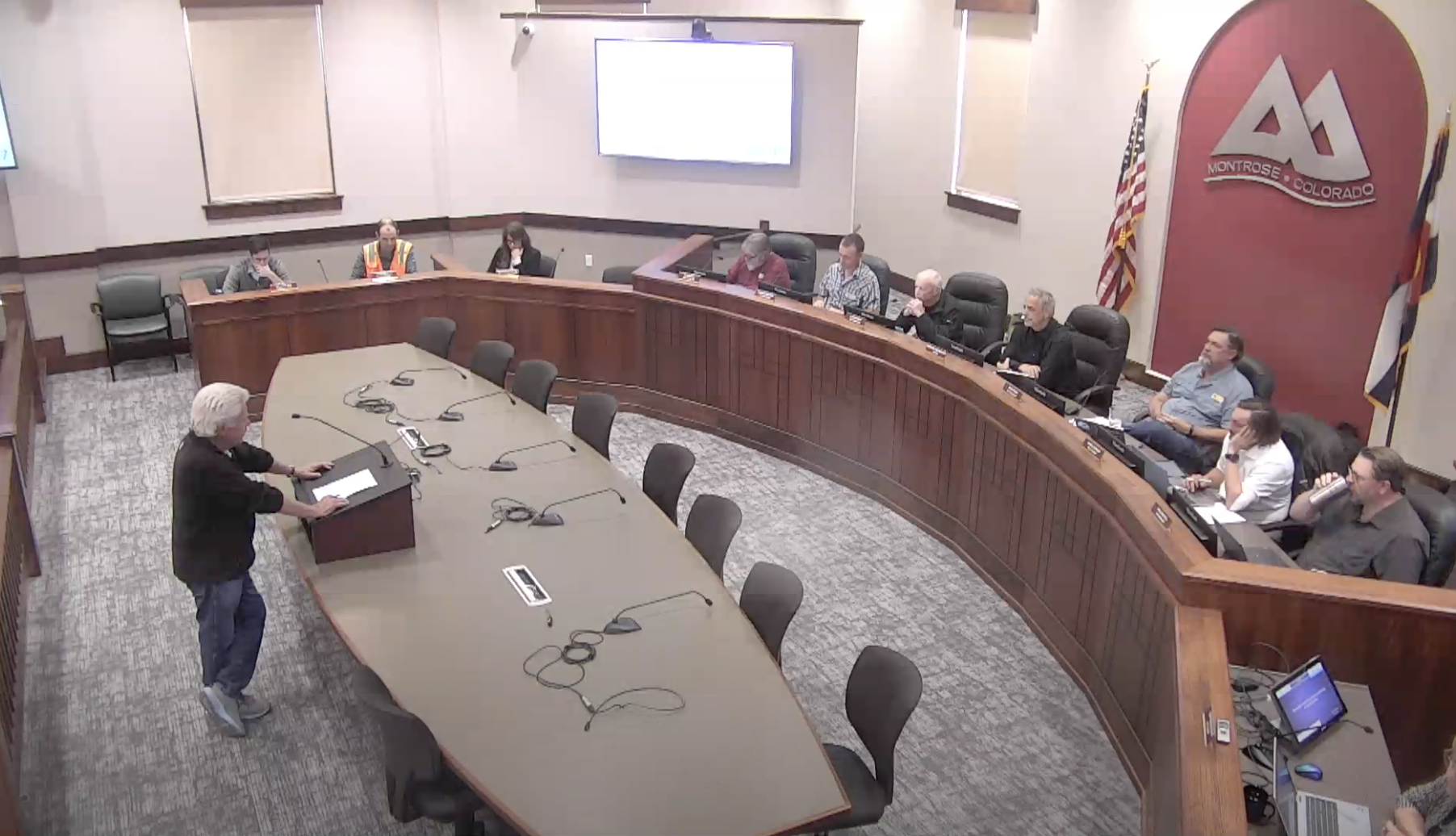
A debate over a Pride Month proclamation, questions about council procedure and growing concerns over immigration-related rhetoric highlighted divisions on the new version of the Montrose City Council during its May 19 meeting.
All of the discussion unfolded during the public comment portion of the meeting, where residents, former elected officials and council members themselves debated issues of inclusion, symbolism, transparency and the role local government should play in recognizing marginalized groups.
At the center of the discussion was the council’s decision not to move forward with a 2026 Pride Month proclamation, despite similar proclamations being read the previous two years, and repeated public discussion about whether the city could eventually declare itself a “non-sanctuary city” as it pertains to illegal immigration.
Debate over proclamations
Questions surrounding the proclamation process surfaced after former mayor and former council member Dave Bowman challenged how the decision had been made.
“I’m trying to figure out without a vote how a decision was arrived,” Bowman said during public comment.
Bowman questioned whether council members had improperly reached a “consensus” outside a public meeting after Councilman David Reed previously referenced a consensus decision during a work session.
“What I’d like to know right now, Mr. Mayor, can you please explain to me how this council that’s not supposed to communicate really outside of this chamber came to the consensus?” Bowman said.
City Manager Bill Bell and City Attorney Chris Dowsey responded publicly, explaining that proclamations are ceremonial rather than official council actions and therefore do not come before council for a formal vote.
Bell said the process used in this case was the same process used in prior years. According to Bell, City Clerk Lisa DelPiccolo contacts council members individually to gauge support for proposed proclamations.
Bell also clarified that the mayor technically has authority to issue proclamations independently, though the city has historically attempted to gauge council support beforehand.
“In this particular case, we did what we’ve always done through the clerk’s office,” Bell said. “Let’s check with everybody.”
Bell publicly disclosed that Mayor Michael J. Badagliacco and council members Ed Ulibarri and Adam Wooden opposed proceeding with the Pride proclamation, while council members Dave Frank and J. David Reed supported it. Bowman argued the process resembled a private decision that should have been discussed publicly.
“You guys are violating your own rule,” Bowman said.
Bell disputed that characterization, saying no open meetings violation occurred because no official vote or formal council action took place.
Pride proclamation debate
The proclamation itself was, as well, a focal point — this one for disagreements about inclusion and the role of symbolic government recognition.
Evelyn Greenman-Baird, speaking on behalf of Montrose Pride, urged council members to reconsider the decision.
“For each of the past two years, under two different mayors, the council read the Pride Month proclamation,” Greenman-Baird said. “What’s new is its absence.”
Greenman-Baird emphasized that the proclamation would not change laws or budgets, but instead represented symbolic recognition of LGBTQ residents within the community.
“It is the city of Montrose saying to over 1,400 residents — your neighbors, your healthcare providers, your business owners and veterans — residents who are deeply woven into the fabric of this city, that you are part of this community,” she said.
Greenman-Baird also referenced the council’s earlier Mental Health Awareness proclamation while discussing mental health concerns.
“For over 1,400 residents in Montrose, it is a mental health intervention, and one that costs this city nothing,” she said. “When recognition is withheld, that too is felt.”
Reed later delivered a prepared statement supporting the proclamation and criticizing the council’s decision not to proceed.
“I am very disappointed by the decision not to issue a proclamation regarding Montrose’s Pride Month this year,” Reed said.
Reed argued proclamations are civic acknowledgments rather than endorsements of ideology.
“Such proclamations do not create rights, confer special treatment or require agreement with every viewpoint represented by a group,” he said. “They are, at their core, statements that every member of our community matters.”
He added that refusing the proclamation risked sending a message that some residents were less valued than others.
“Our city is strongest when people know they are seen, valued and welcomed,” Reed said.
Badagliacco defended his position while also insisting LGBTQ residents remained welcome in the city.
“I think that we can all agree that any government entity granting preferential status to any segment of the citizenry, whether by proclamation or other means, would undermine the fundamental fairness owed to every citizen,” Badagliacco said.
He later added that his opposition was not directed at LGBTQ residents themselves.
“My commitment is to make sure that everyone is welcome and everyone is honored and everyone is able to live their life authentically,” he said.
However, Badagliacco said he did not believe government should issue proclamations tied to specific groups.
“I just don’t think it’s government’s place to make those proclamations,” he said.
Greenman-Baird, allowed a response by the mayor, said that symbolic recognition was precisely one of local government’s responsibilities.
“I believe it is exactly the place of government, especially local government, to ensure that all of its citizens feel welcome, feel at home here,” she said.
Immigration debate emerges
The meeting also featured repeated public comments regarding immigration and concerns that the city could eventually pursue a “non-sanctuary city” declaration.
Those concerns intensified following a recent opinion piece published by Badagliacco in the Montrose Mirror, where the mayor discussed constitutional law, immigration policy and opposition to sanctuary policies.
In the column, Badagliacco described the United States as “a Constitutional Republic” built on “law and order,” argued that federal immigration law supersedes state and local policy through the Supremacy Clause and stated that “the law is the law.”
“I am proudly pro-immigrant and pro-legal immigration, not anti-immigrant,” Badagliacco wrote. “What I oppose is lawbreaking.”
The Montrose Business Times reached out to Badagliacco to determine whether he intends to have a “non-sanctuary” declaration on a future City Council agenda but didn’t receive a reply by publication time.
Public commenters repeatedly referenced the article during the May 19 meeting.
Resident Kim Spangrude praised the city for adding Spanish-language translation services to the meeting but warned that a future non-sanctuary declaration could undermine trust within the Hispanic community.
“If you build it, they will come,” Spangrude said, referring to the city’s decision to provide translation services.
“But if Montrose were to formally declare a non-sanctuary proclamation, that symbolic act would have potentially negative consequences,” she added.
Spangrude argued that many residents could interpret such a declaration as signaling cooperation with federal immigration enforcement beyond what Colorado law allows.
Former city council candidate Ryan Sedgley connected the proclamation issue and sanctuary-city discussions to what he described as change in tone from the new council.
“You have an opportunity still to not go down that road,” Sedgley said.
Sedgley asked the council to reconsider the Pride proclamation and avoid what he described as divisive messaging.
“Tell this community that you are inclusive, that everybody does matter,” he said.
Resident Dave Stockton also criticized the possibility of Montrose declaring itself a non-sanctuary city, referencing his family’s immigrant background and arguing such declarations send exclusionary messages.
“Is supporting non-sanctuary status being driven by national politics or is it something embraced by all of Montrose?” Stockton asked.
Ulibarri responded directly to Stockton during the exchange, as Stockton asked Ulibarri whether he was setting a good example for the children he mentors. Ulibarri said his views were rooted in respect for laws regardless of political opinion.
“I teach them self-control, focus and respect,” Ulibarri said, referring to children he mentors. “When I talk about respect, I’m talking about respecting the law.”
“The law is the law, whether it’s right, wrong or indifferent,” he added.
Stockton replied that “there’s law and there’s justice” before Mayor Badagliacco ended the exchange due to time limits.
Justin Tubbs is the Montrose Business Times editor. He can be reached by email at justin@montrosebusinesstimes.com or by phone at 970-765-0915 or mobile at 254-246-2260.